
Gogebic Projected Versus Actual Release
“Projected release date” is a useful search phrase, but Michigan records use more exact labels. For an MDOC prisoner, OTIS displays a Parole Board Jurisdiction Date. The official field explanation calls it the Earliest Release Date. It is the first date when the Board may have jurisdiction under the sentence and any credits that lawfully apply. It is not a promise of parole, a scheduled gate date, or proof that the person left prison.
Actual release requires an event. OTIS Date Paroled records departure from prison to parole. A status of PAROLE means the person is outside prison but remains under MDOC supervision. DISCHRG means MDOC jurisdiction for that sentence ended, although the official definition can include death. A jail release record provides the physical departure facts for Gogebic County Jail. The court order supplies legal authority but may not state the exact time the jail completed processing.
A pretrial detainee is different. Before conviction and sentence, no ordinary sentence calculation produces a fixed Gogebic County release date. Bond, dismissal, a court order, another hold, or case progress may control whether and when the person leaves. A transfer to another authority also ends the local jail stay without creating a community release.
Find Gogebic MDOC Release Dates
Use OTIS only when the person has an MDOC prison or supervision record. It excludes people held only in county jail, city lockups, and people arrested or convicted but never sentenced to MDOC supervision. Search with the offender number when known because that unique number is the safest match. A name search can be narrowed by first name, sex, race, age, status, or marks, scars, and tattoos.
- Open the MDOC Offender Tracking Information System.
- Enter the last name or offender number. A last-name wildcard can follow at least three initial letters.
- Select All when status is uncertain. Use Parolees or Discharged only when the expected status justifies that filter.
- Open the matching record and confirm identity from the offender number, name, birth date, photograph when present, and conviction details.
- Read status, Parole Board Jurisdiction Date, Maximum Date, and Date Paroled as separate fields.
- Confirm a physical release with Date Paroled, current status, and formal MDOC records when stronger proof is needed.
The OTIS search screen shown here includes status choices that help distinguish prisoners, parolees, probationers, and recently discharged people.
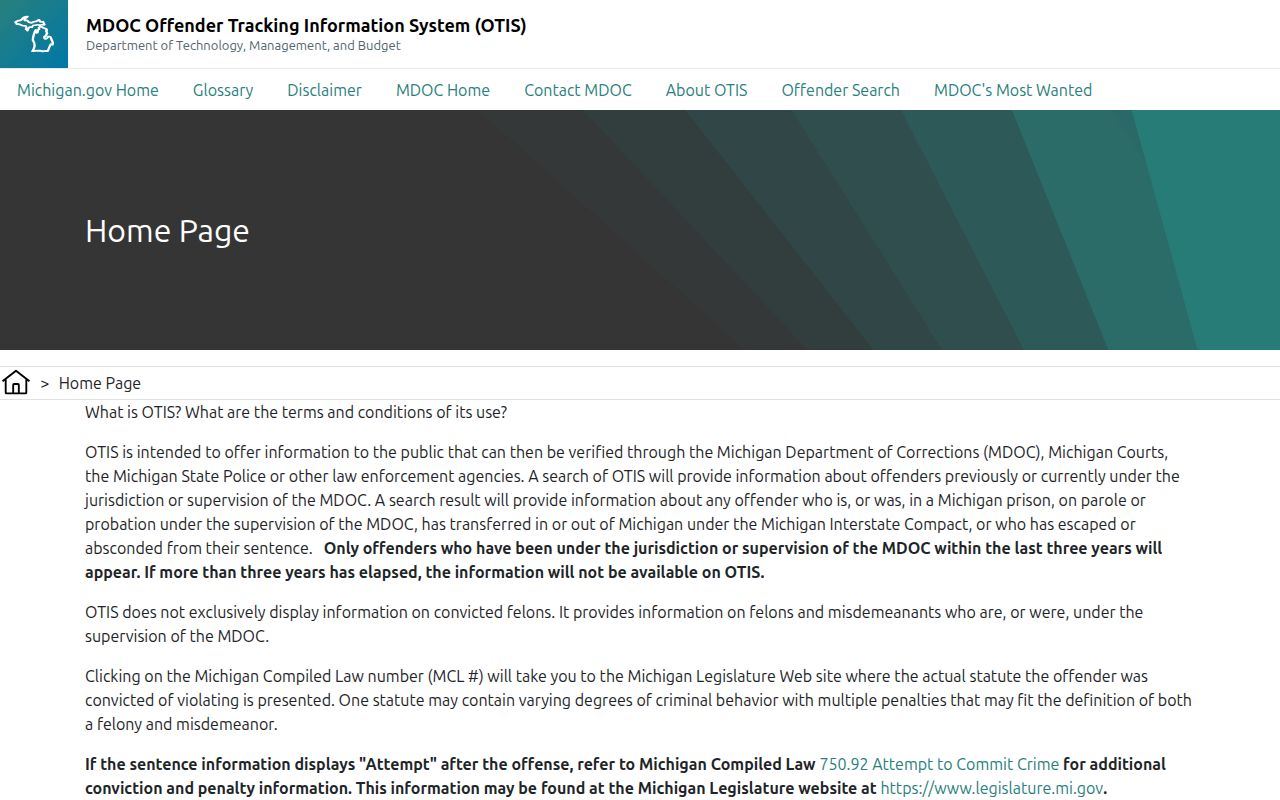
Those filters narrow a state-corrections record. They do not convert a county-jail-only case into an MDOC case.
OTIS normally keeps discharged people public for three years after the most recent MDOC discharge. A new supervision term restarts that period, while a set-aside or other access rule can change visibility. A missing result may therefore require MDOC records or the sentencing court. It should not be treated as proof that no prior sentence or release occurred.
Note: For a probationer, the jurisdiction-date column serves a supervision-release function, so status must always accompany the displayed date.
Read Gogebic Release Date Fields
Each OTIS date answers a different question. The official OTIS field definitions should control when a label seems unclear. Reading one date by itself creates a high risk of calling eligibility an actual release.
| OTIS field | Meaning for release timing |
|---|---|
| Parole Board Jurisdiction Date | The Earliest Release Date for a prisoner, meaning the first date the Board may have jurisdiction. |
| Date Paroled | The actual date the person left prison for community parole supervision. |
| Maximum Date | The possible maximum endpoint under the controlling sentence and applicable credits. |
| Status | Provides the context needed to read the dates, such as PRISON, PAROLE, or DISCHRG. |
The Maximum Date is not always the expected exit date. A parole decision could allow earlier departure after eligibility and processing, while a person may remain until a later lawful point. Likewise, Date Paroled does not mean the whole sentence and all oversight ended. Parole is supervised community release. Final MDOC discharge is a separate milestone.
The field-definition page in the successful manifest shows the labels used to interpret a Gogebic County projected release date.
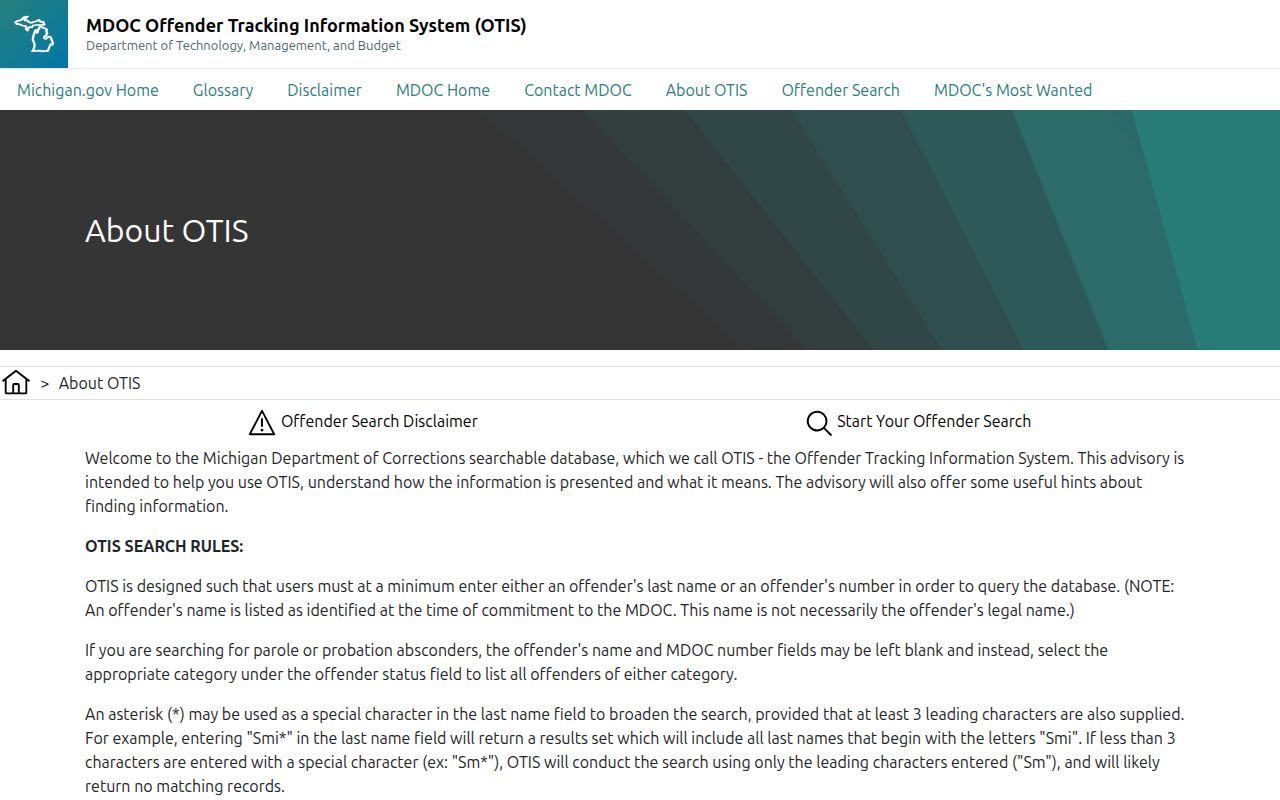
Keeping those terms distinct prevents an eligibility date from being repeated as a confirmed release date.
Gogebic Truth In Sentencing
Michigan should not be called an 85-percent state. The MDOC truth-in-sentencing explanation says covered prisoners serve the full court-imposed minimum in prison before parole consideration. It applies to specified assaultive crimes committed on or after December 15, 1998, and all other crimes committed on or after December 15, 2000.
For that population, good time, special good time, disciplinary credits, and special disciplinary credits do not shorten the minimum. Disciplinary time records days linked to Class I misconduct. MDOC says it is not formally added to the judicial minimum, but the Parole Board may consider it. MCL 791.234 governs when the Board gets jurisdiction, while MCL 791.233 makes release discretionary under the statutory public-safety standard. Reaching the date creates review authority, not entitlement to leave.
The official truth-in-sentencing page captured below explains why a generic percentage cannot produce a sound Gogebic County projected release date.
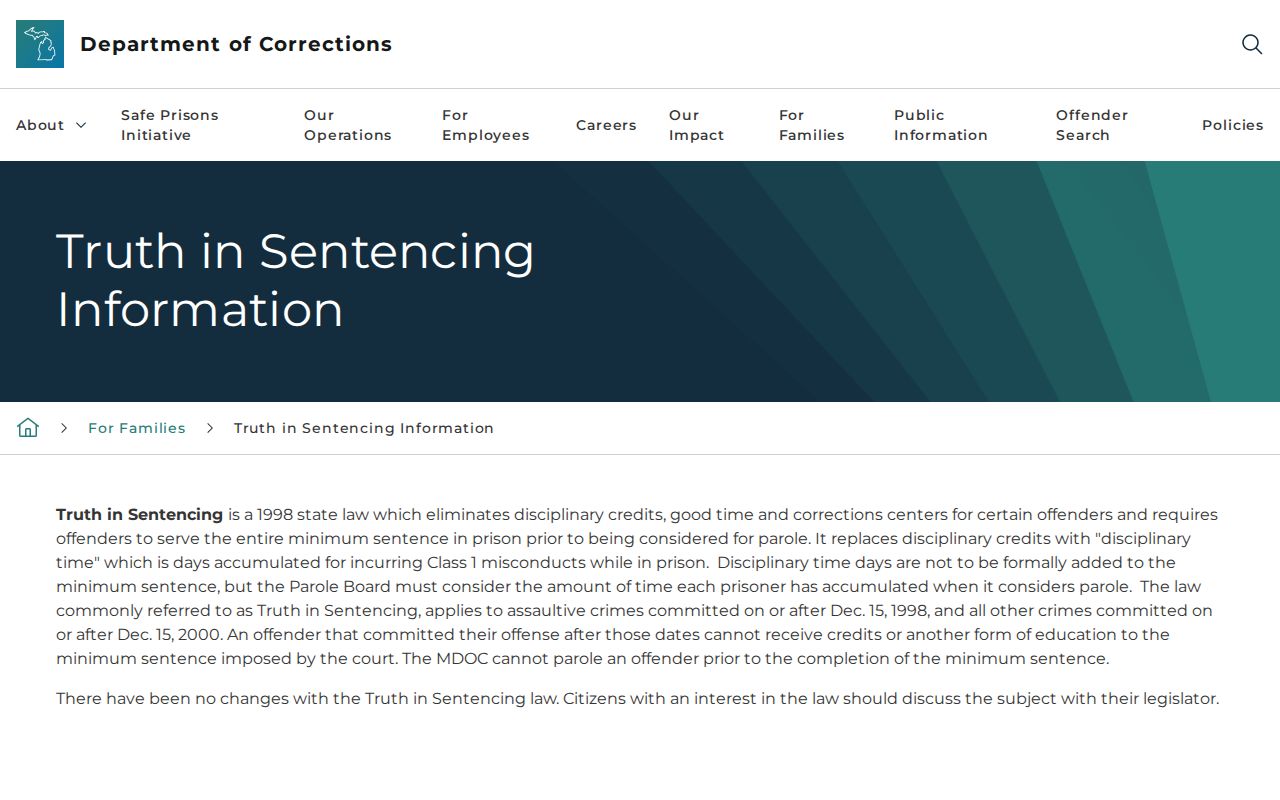
The offense date and sentence type must be known before deciding which credit rules apply.
Legacy Gogebic Release Credits
Older offense dates may fall under prior good-time or disciplinary-credit rules. MCL 800.33 is the cited framework for eligible legacy sentences. MDOC’s glossary states that disciplinary credits may advance eligibility by five days per month, with as many as two more days for exceptionally good conduct, up to 84 days in a year. Major misconduct can cost the month’s credits, and previously earned credits may be forfeited.
Those figures must not be applied to a truth-in-sentencing case. The correct computation can depend on offense date, consecutive terms, jail credit, the controlling sentence, misconduct, resentencing, and court corrections. Subtracting a standard percentage from the minimum ignores those facts. OTIS supplies the current public date. MDOC and court records can explain how it was calculated.
- Minimum sentence
- The court-imposed period that controls the start of parole eligibility under the applicable law.
- Earliest Release Date
- OTIS terminology for the date the Parole Board first may obtain jurisdiction over a prisoner.
- Parole
- Release from prison into the community while MDOC supervision continues.
- Detainer
- A request or legal hold from another authority that can affect where a person goes next.
Definitions clarify the process, but they cannot resolve a person’s calculation. A formal sentence, offense date, and current MDOC record are required for that person.
Gogebic Jail Release Calculations
No Gogebic County Jail good-time policy or weekend-release rule was found in the official-source sweep. A county sentence is administered through the court and jail, not OTIS. Ask for the existing sentence or release computation. Confirm the actual departure through the jail release record. Michigan’s state-prison truth-in-sentencing rules should not be imported into a local jail term without specific authority.
For present custody, call Gogebic County Jail at 906-667-0203. If the person is not held, ask whether staff can distinguish release from transfer and whether an existing release record can be requested. The 98th District Court search covers misdemeanors and preliminary felony stages. The 32nd Circuit Court search covers felony adjudications. A sentence, bond order, dismissal, jail-credit entry, or transfer order may explain the legal event.
When an exact record is required, use the Gogebic County FOIA hub and ask for the existing booking/release sheet or jail-register entry. A focused request can identify the person, a tight date range, release date and time, release authority or type, and receiving agency if transferred. Michigan FOIA generally calls for an agency response within five business days, with one written extension of up to ten business days available. That is a response timetable, not a promise of record delivery on a fixed date.
Why Gogebic Release Dates Change
A public date can change because it reflects a legal and administrative process, not a simple countdown. Some factors alter eligibility. Others affect the decision, the release plan, or the destination after custody. The responsible agency record should identify which stage changed.
| Factor | Possible effect |
|---|---|
| Sentence correction or resentencing | Changes the legal terms used in the date computation. |
| Eligible legacy credit loss | Can delay eligibility when the older statutory credit system applies. |
| Parole deny or defer | Leaves the prisoner in custody beyond the first Board-jurisdiction date. |
| Suspended grant | Stops a positive parole decision before physical release. |
| Placement or treatment planning | Can delay final release processing after a favorable decision. |
| Detainer or another hold | May send the person to another authority rather than the community. |
MDOC says routine parole review generally begins about six months before eligibility or reconsideration. A positive decision still needs release work. At least 28 days are required between the Board decision and physical release. A grant, eligibility date, and gate date are therefore three different milestones. New misconduct or adverse information can also suspend a grant before departure.
Note: Another authority’s detainer can change the destination without changing the fact that the person left the first facility.
Confirm Gogebic Actual Release Dates
Use the narrowest authoritative record. For a state prisoner, read OTIS Date Paroled and status together. Request the parole or discharge record when formal proof is needed. For a Gogebic County Jail departure, use the jail’s release entry for the physical event and the court file for legal authority. A court order can precede the gate time because jail staff still must process the exit.
Prospective notice can supplement those records. The Gogebic County VINELink inmate search explains how to register for covered release or transfer alerts. Treat the alert as a prompt to verify, not the last word. If it reports transfer, identify the receiving authority before saying the person entered the community.
The broader Gogebic County released-inmate lookup routes jail, state, court, and federal cases to their correct sources. That custody-type check is essential when the first source has no result. BOP wording applies only to federal custody. ICE release applies only to ICE custody. Neither proves the outcome of a Gogebic jail or MDOC sentence.
Preserve the date and source used for the check. Online status can change after later processing, correction, discharge, or a public-access limit. A saved screenshot shows what the portal displayed on one date, but it is not a certified record. When the exact result has legal significance in a court or records process, obtain the agency-created document rather than relying on a copied screen.