
Gogebic Parole and Probation
Parole and probation both place a person in the community under rules, but they begin at different points. Parole follows confinement in a Michigan Department of Corrections prison. The person has physically left prison while MDOC jurisdiction continues. Probation is a court-ordered community sentence. It may follow a county jail term, or the court may impose it without prison. An OTIS probation result therefore does not prove that the person was released from state prison.
Gogebic County also has two probation structures that should not be merged. MDOC field staff supervise state parole and circuit-court probation. The 98th District Court operates its own local probation program for district matters. A historic conviction in Gogebic County does not by itself prove that the person is now assigned to the local MDOC office. Current OTIS and agency records control.
| Status | What it means | Best public check |
|---|---|---|
| Parole | Release from MDOC prison into continued state supervision | OTIS status, Date Paroled, and supervision location |
| MDOC probation | State field supervision ordered in a circuit matter | OTIS probation status and assigned office |
| District probation | Local court supervision in a district matter | 98th District Court probation and case record |
| Discharge | End of the named supervision or MDOC jurisdiction | OTIS, court order, or formal discharge record |
- Parole
- Conditional release from prison while state supervision continues.
- Probation
- A community sentence monitored under a court order.
- Discharge
- The formal end of the specified supervision or jurisdiction.
- Absconder
- A person who has left supervision without permission, not a lawful release status.
Verify Gogebic Post-Release Supervision
The Offender Tracking Information System, known as OTIS, is Michigan’s main public check for MDOC parolees, probationers, and recent discharges. Search by MDOC number when it is known because that unique number avoids name matches. A name search can be narrowed by first name, age, sex, race, status, or marks, scars, and tattoos. Selecting “All” is safer when the supervision type is not yet clear.
- Open OTIS and search by offender number or last name. Use the minimum identifying details needed to distinguish records.
- Open the matching result and compare the name, birth date, offender number, conviction data, and photograph when one is available.
- Read Status with Date Paroled and location. “PAROLE” supports release from prison into supervision. “PROBATION” does not establish prison release.
- If OTIS shows no MDOC result, check the Gogebic District Court probation office and the correct court case.
- Contact the office tied to the live record if a status or assignment needs correction. Do not assign the Gogebic office based only on an old local case.
OTIS generally keeps a discharged person visible for three years after the most recent MDOC discharge. A missing result can reflect spelling, an older discharge, set-aside rules, or a case outside MDOC jurisdiction. It is not proof that supervision never existed. The MDOC records guidance describes formal materials, including a discharge certificate or PENPACK, when a durable record is needed.
Date fields need the same care as status codes. Date Paroled is the actual departure from an MDOC prison to parole. The Parole Board Jurisdiction Date is an eligibility point for a prisoner, not a scheduled release, while Maximum Date marks a potential sentence endpoint. For a probationer, the jurisdiction-date column can represent a supervision-release date instead. Always read the date with the record type. A profile that lists parole also does not prove the person reports in Gogebic County. The supervision location or a direct office confirmation must make that local connection.
Gogebic Supervision Offices Differ
The state and local offices share a courthouse address, which makes labels crucial. The MDOC Region 1 directory lists the Gogebic County Parole/Probation office for state parole and circuit probation. The county’s separate probation page covers district matters. Neither source publishes a universal walk-in procedure. Call first and follow the instructions tied to the person’s case or OTIS assignment.
MDOC Gogebic County Parole/Probation200 N. Moore Street
Bessemer, MI 49911
906-667-0323
Walk-in hours not published
The official Region 1 page shows the local state-supervision contact. Its layout can be reviewed at the MDOC office directory source.
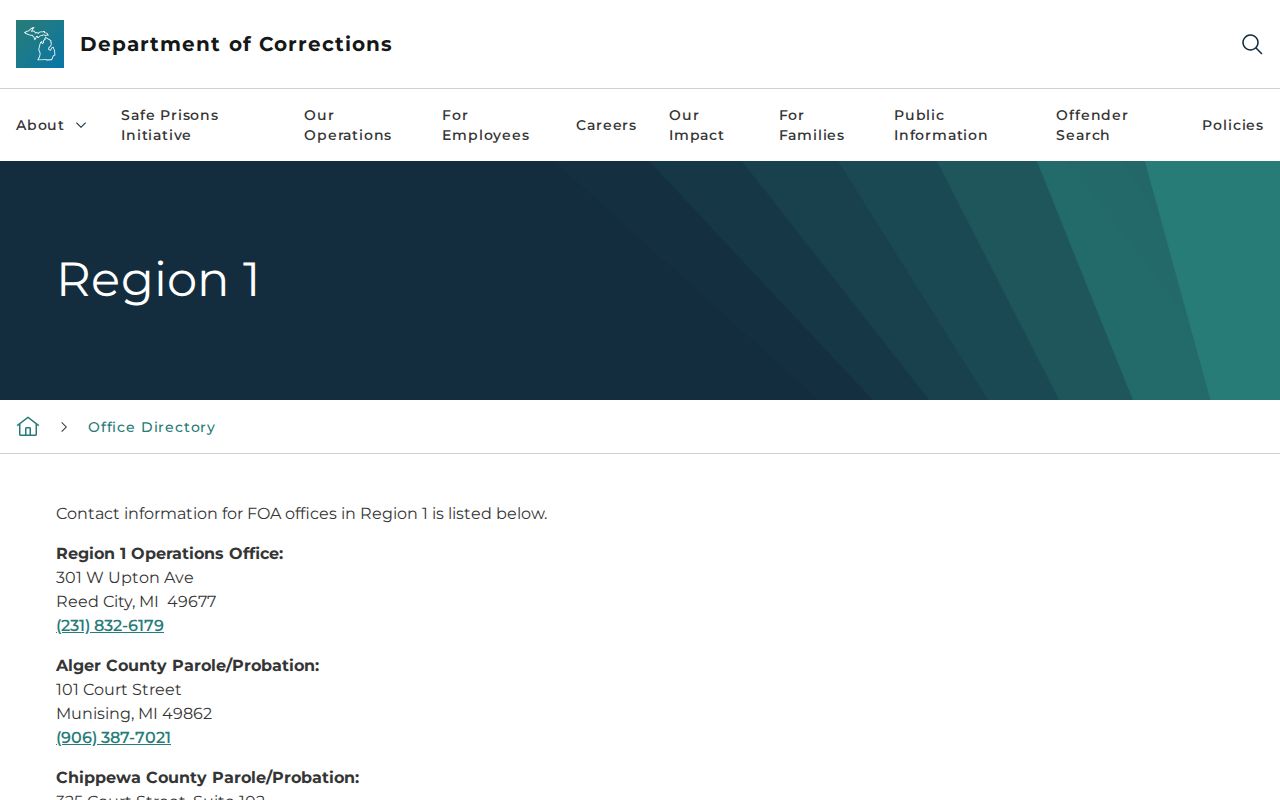
The capture anchors the address to MDOC, but the current OTIS record must still tie a particular person to that office.
The Michigan Parole Board performs another distinct role. It considers release from prison under Michigan law and maintains its own official contact channels. Board eligibility is not a promise of release. MCL 791.234 controls when jurisdiction begins, and MCL 791.233 requires the statutory public-safety judgment. A person-specific result is best checked in the processed MDOC record. Public-hearing notices cover a limited class of hearings, while quarterly reports are aggregate and cannot establish one person’s decision.
Gogebic District Probation Records
The 98th District Court probation operation prepares sentencing reports, supervises probationers, monitors court conditions, and makes referrals. This local function is not the Michigan Parole Board and is not proof of a state-prison release. The court docket may show the probation order, later review events, alleged violations, and discharge action. Read the actual order rather than relying on a brief status label.
The official county probation page shows the separate district-court role.
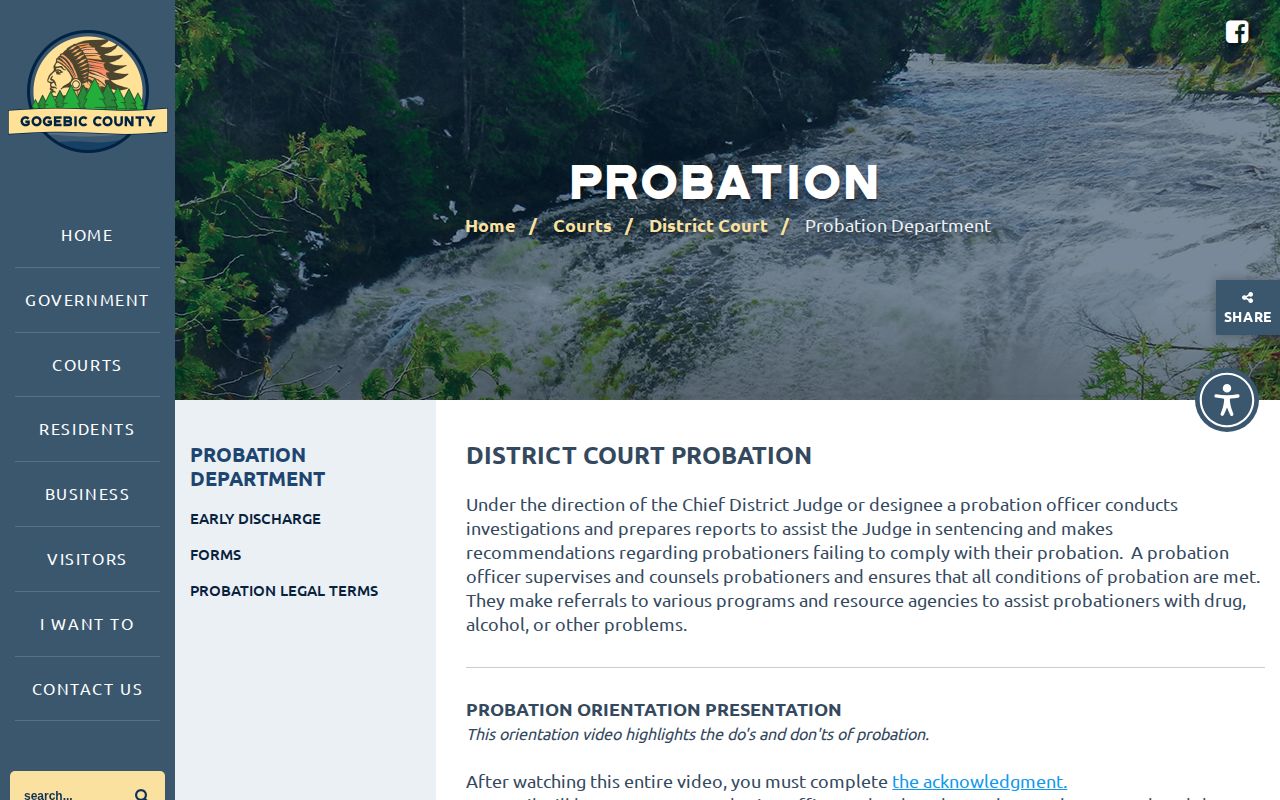
This source is the right local starting point when OTIS does not cover the district probation case.
For the case itself, use D98 MiCOURT for a district misdemeanor or preliminary felony stage. A felony adjudication proceeds through C32 Circuit Court. Court entries can explain why supervision was imposed or ended, while a jail release sheet remains the stronger record for an exact physical departure from Gogebic County Jail.
Gogebic Absconder Status Checks
OTIS offers separate Parole Absconders and Probation Absconders status choices. An absconder has left authorized supervision. That is not successful completion, discharge, or a fresh release. A listed absconder location may be only the last supervision location, not a present physical location. No official Gogebic County warrant or absconder list was found, so the statewide status and the responsible office are the sound channels.
Conditions vary by order and case. They may involve reporting, treatment, travel limits, or other specific duties, but no universal set should be inferred from a public status. A claimed violation is handled through the supervising authority and court or Board process. MI-VINE can provide covered custody or court-change alerts, but it does not replace an OTIS supervision record or an order.
Gogebic Probation Early Discharge
Gogebic District Court publishes an unusually specific route for possible early discharge from probation. The local early-discharge instructions say a case may qualify after half of the probation term when all conditions are complete and there have been no violations for at least three months before eligibility. Exclusions apply, and MCL 771.2 governs the route. Eligibility does not guarantee approval.
The officer may request discharge. Otherwise, the person may use SCAO form MC 512 with a letter to the judge, submit the materials to the probation officer, and contact the officer after 14 days. This is a later supervision milestone. It does not establish when someone left Gogebic County Jail and must not be used as a substitute for the original Gogebic County release record.
The county’s published process appears in the official source shown below.
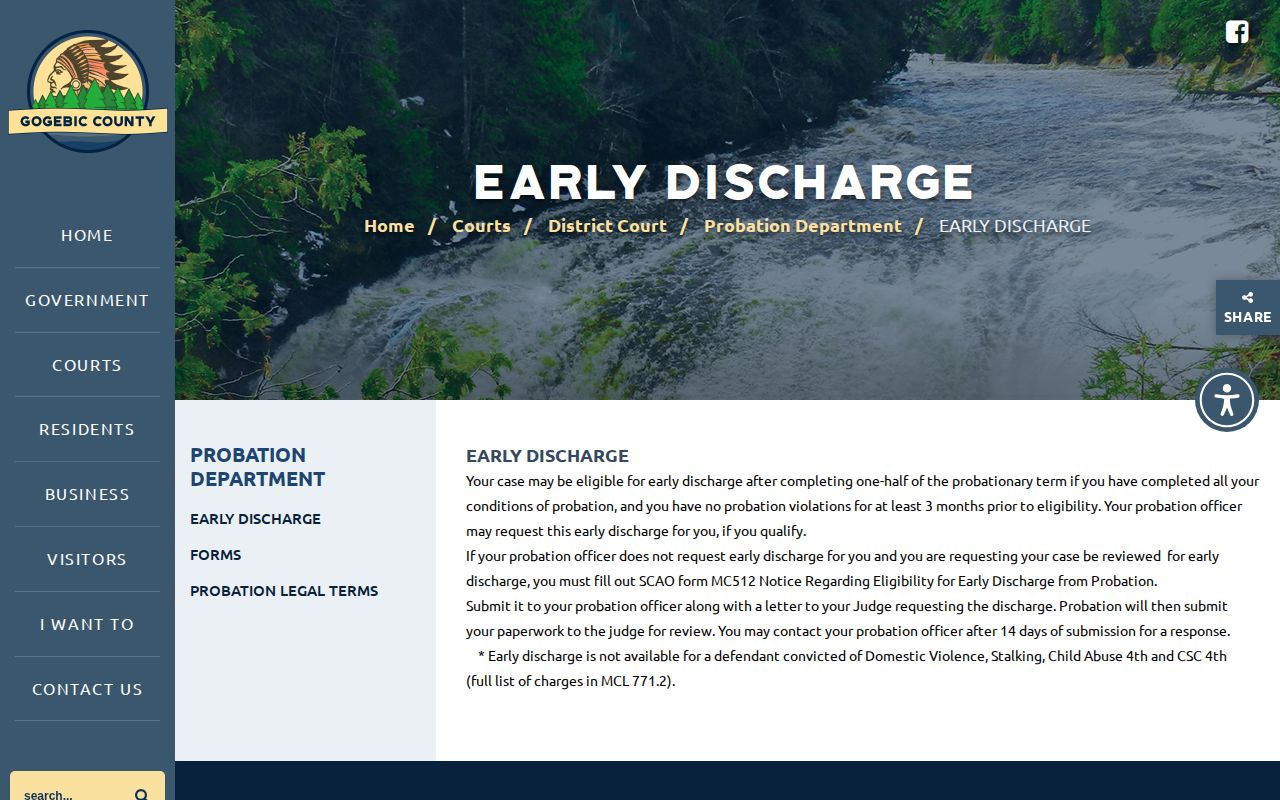
The page helps separate court-approved supervision discharge from an earlier jail or prison release.
Gogebic Supervision Discharge Records
Supervision ends through an authorized discharge, maximum-term completion, court order, or another case-specific event. For MDOC cases, `DISCHRG` means MDOC jurisdiction for that sentence ended. MDOC cautions that the code can also reflect death before completion, so it must not automatically be translated as a return home. Read the dates and obtain the discharge certificate when the precise conclusion matters.
For district probation, the court order and probation file document the end of local supervision. For parole, OTIS and MDOC records are the first checks. These records answer a different question from the county jail release sheet. Keeping the event and the agency together produces the most accurate statement: released from prison to parole, discharged from MDOC, or discharged from district probation.
When a status changes, save the source date and identify the office that created the record. An OTIS screen can show a timely public status, but it may change after MDOC processes a new event or correction. A court docket can show that a judge entered discharge, yet the signed order is the stronger court record. MI-VINE may deliver a useful alert, though it is built for notice rather than a permanent supervision archive. If two sources disagree, first ask whether they describe the same event. Prison departure, assignment to parole, and final discharge are separate milestones.
For an older MDOC case that no longer appears online, request the narrow record needed from MDOC and consult the sentencing court. For a district case, contact the 98th District Court probation operation. Give private identifying data only through the agency’s request channel. Public discussion rarely needs more than the person’s name, record number when appropriate, status, relevant date, and supervising authority. This keeps the verification precise without repeating details that do not help establish Gogebic County supervision.