
Understanding Gogebic County Releases
A person can leave Gogebic County Jail for several very different reasons. Bond may let the person return to the community while the case remains open. A court may dismiss a charge, grant credit for time served, or direct release. A county sentence may end. The jail may also transfer the person to the Michigan Department of Corrections, another jail, the U.S. Marshals Service, or immigration custody. Only some of those events are community releases.
The source must match the event. The Sheriff holds the operational jail record. The 98th District Court or 32nd Circuit Court holds the order that explains the legal basis. MDOC records a later prison parole or discharge. MI-VINE can give notice of a covered custody change, but it is not a permanent release archive. A Gogebic County released inmate therefore cannot be confirmed by one universal list.
- Parole
- Release from state prison into continued MDOC supervision.
- Probation
- A court-ordered community status that may follow jail or may be imposed without prison.
- Discharge
- The end of MDOC jurisdiction for the specified sentence.
- Time served
- Completion of the custodial part credited by the court, though another duty or case may remain.
Gogebic County Release Types
The word “released” needs an object. Someone may be released from the county jail, paroled from a state prison, discharged from MDOC, or released from federal or ICE custody. A transfer is just a departure from one facility. It does not mean the person went home. The release type and destination fields, when maintained, keep those outcomes from being blurred.
| Event | What it means | Best next source |
|---|---|---|
| Bond or court release | The local jail hold ends under a court order while the case may continue. | Jail release sheet and D98 or C32 court file |
| Time served | The credited jail term ends, though probation or another case may remain. | Jail record and sentencing order |
| Parole | The person leaves an MDOC prison and remains supervised. | OTIS status and Date Paroled |
| Discharge | MDOC jurisdiction for that sentence ends. | OTIS plus discharge certificate or PENPACK |
| Transfer | The person leaves Gogebic custody for another authority. | Receiving-agency field, court record, then the new locator |
| Dismissal | One case may no longer support detention, but other holds still must be checked. | Actual court order and jail record |
Escape, absconding, and death are not lawful community release types. OTIS lists parole and probation absconders separately. Its discharge definition can also include death before sentence completion, so a `DISCHRG` result must not be paraphrased as a safe return home without more proof.
Gogebic Bond Release Records
Gogebic County’s 98th District Court identifies a Pretrial Release Officer and Sobriety Court Officer. That local role helps show why a bond release differs from sentence completion. The person leaves jail under terms set by the court, while hearings and release conditions can continue. No official local bond schedule or payment method was found in the research, so the actual order controls.
Use the 98th District Court information and the matching D98 case record for misdemeanor cases and early felony proceedings. If a felony moved to Circuit Court, use C32 instead. A booking disappearance does not show whether bond was posted, a judge signed an order, or a transfer occurred.
A bond release ends the jail hold under conditions. It does not dismiss the charge or end the case.
Gogebic County Release Record Fields
No public Gogebic County release sheet was available to transcribe field for field. The records request should therefore describe the existing booking/release sheet or jail-register entry and ask for listed fields only if the jail maintains them. This avoids claiming that every item appears on one county form. It also keeps the request focused on the event.
| Requested field | What it can establish |
|---|---|
| Name and booking identifier | Which custody record belongs to the person |
| Booking date and time | When county custody began for that booking |
| Release date and time | When the recorded departure was processed |
| Release type or authority | Bond, court order, sentence completion, transfer, or another basis |
| Court and case number | Which court file explains the legal action |
| Bond status | Whether a bond event was tied to the departure |
| Receiving agency or destination | Whether the event was a transfer rather than community release |
The court record adds legal context. It may show charges, dismissal, bond action, jail credit, judgment, probation, and later discharge entries. Yet the docket is not always the physical exit log. A court order can precede jail processing, and another hold can prevent departure.
Request Gogebic County Release Records
Gogebic County provides a FOIA hub, a type-enabled request form, a policy, and a summary. Address the request to the current coordinator named by those materials. The public county contact is 200 N. Moore Street, Bessemer, MI 49911, at 906-667-0411. Operational jail questions go to the Sheriff and jail at 100 W. Iron Street, Bessemer, at 906-667-0203.
- Identify the Sheriff as owner of the county booking and release record. Use the court clerk for the court order and MDOC for a state parole or discharge file.
- Give the full name, a narrow date range, and another known identifier. Ask for an existing release sheet, jail-register entry, or ordinary export.
- List the few fields needed, such as release date and time, release authority, and receiving agency. Ask for the booking photo separately if it is needed.
- Request the record in its existing electronic format. Do not ask staff to research a question or create a new report.
- Review any fee estimate, redactions, and cited exemptions. Narrow a broad request before authorizing work if the estimate is high.
Michigan FOIA generally calls for a response within five business days. A public body may issue one written extension of up to ten business days. That is a deadline for its response choice, not a promise that every record will arrive in five days. MCL 15.234 permits charges for allowed labor and other actual incremental components under published procedures, so there is no safe fixed price to quote.
The successful manifest capture of the Gogebic County FOIA hub shows the official starting point.
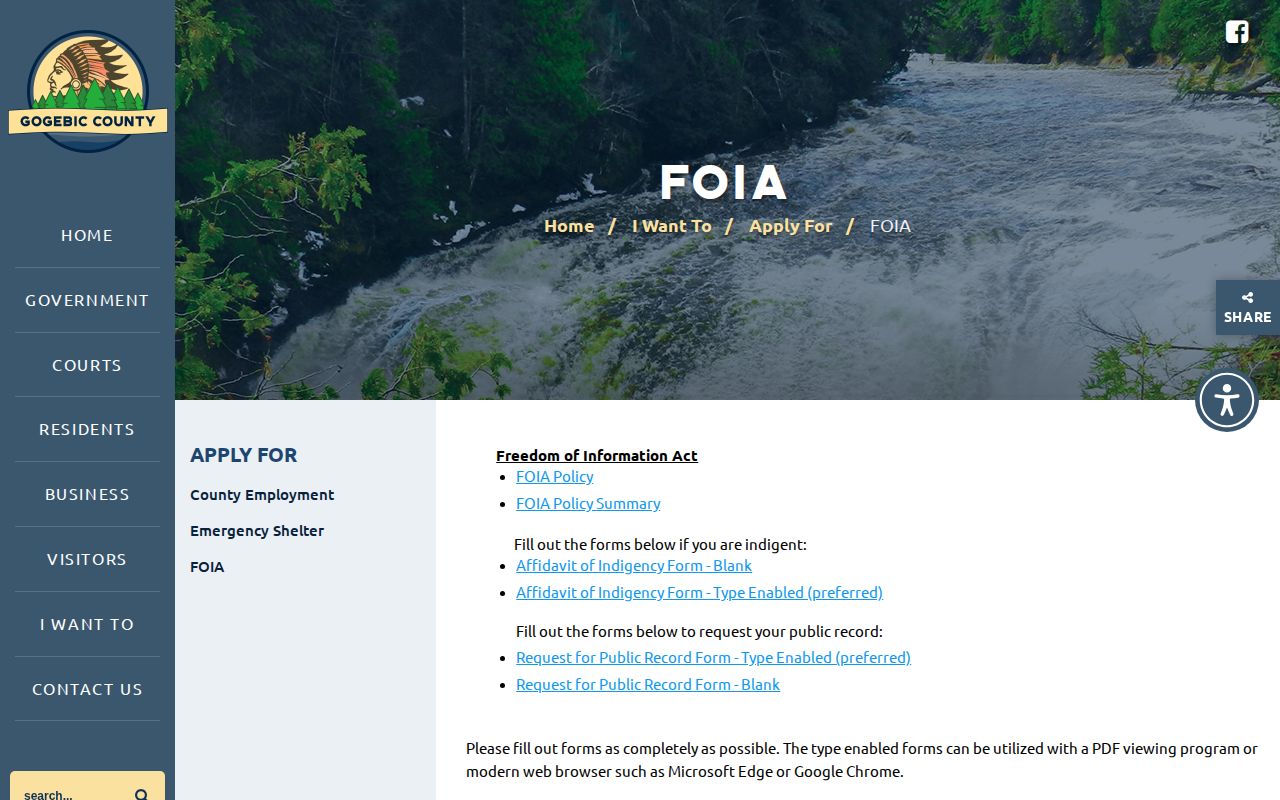
The county form and policy should be checked again before filing because delivery instructions and contacts can change.
Gogebic Release Records and Set-Asides
MCL 15.231 begins Michigan’s public-access framework. MCL 15.235 governs the response process, while MCL 15.243 lists exemptions. A booking photograph or release sheet should be requested as an existing record, but disclosure can still be limited by juvenile status, privacy rules, court sealing, an investigation, or another lawful exemption.
Set-aside rules can change what appears online. Michigan’s automatic process may set aside eligible misdemeanors seven years after sentencing. Eligible felonies use ten years after sentencing or release from MDOC, whichever is later, subject to caps, exclusions, and other legal requirements. MCR 8.119 restricts access to set-aside information and calls for redaction from public releases.
That is a visibility rule, not proof that a historic custody event never happened. A missing MiCOURT case may also reflect a wrong spelling, the wrong court, juvenile restrictions, or sealing. Ask the correct clerk for the public file and avoid drawing a conclusion from absence alone.
Note: No official Gogebic jail roster retention period was found, while OTIS generally keeps a discharged person visible for three years after the latest MDOC discharge.
Find Gogebic County Released Inmates
Gogebic County publishes no official online inmate roster or recent-release feed. The search must begin with custody type and then move through the local record chain. A “not in custody” response answers only the present-tense question. It does not explain release type, departure time, or a transfer.
- Call Gogebic County Jail at 906-667-0203 and ask whether the person is presently held. Ask whether staff can distinguish a release from a transfer.
- Search D98 MiCOURT for misdemeanors or preliminary felony stages. Search C32 MiCOURT for felony adjudication. Match the right person and read the actual order.
- Use MI-VINE for a specific covered person and prospective notifications. A past alert can support a custody change but may not explain it.
- If an MDOC sentence or state supervision is involved, search OTIS with Parolees, Discharged, or All. Do not use OTIS for a jail-only sentence.
- Use BOP or ICE when the responsible authority is federal. USMS pretrial history may require a targeted federal records request.
- Request the Sheriff’s booking/release record when an exact time, authority, or destination is required.
Released people normally leave an active-custody roster. Use the event record, court order, or correct post-custody locator to learn what happened.
A time-bounded county list requires a records request because the Sheriff does not publish a live feed. Ask for an existing Gogebic County daily release export with exact start and end times rather than demanding a new report.
Gogebic Release Court Search
Gogebic County has two direct MiCOURT paths. The D98 search covers District Court misdemeanors and preliminary felony work. The C32 search covers Circuit Court felony adjudications. A felony can appear in both as it moves from preliminary proceedings to Circuit Court.
Read the register of actions and the actual order. A disposition can show why release became lawful, but it may not record the gate time. Gogebic County also warns that `REVIEW` in the next-hearing field is an automated internal scheduling term. It does not mean the person has an in-person release hearing.
The official D98 MiCOURT portal appears in the captured interface below.
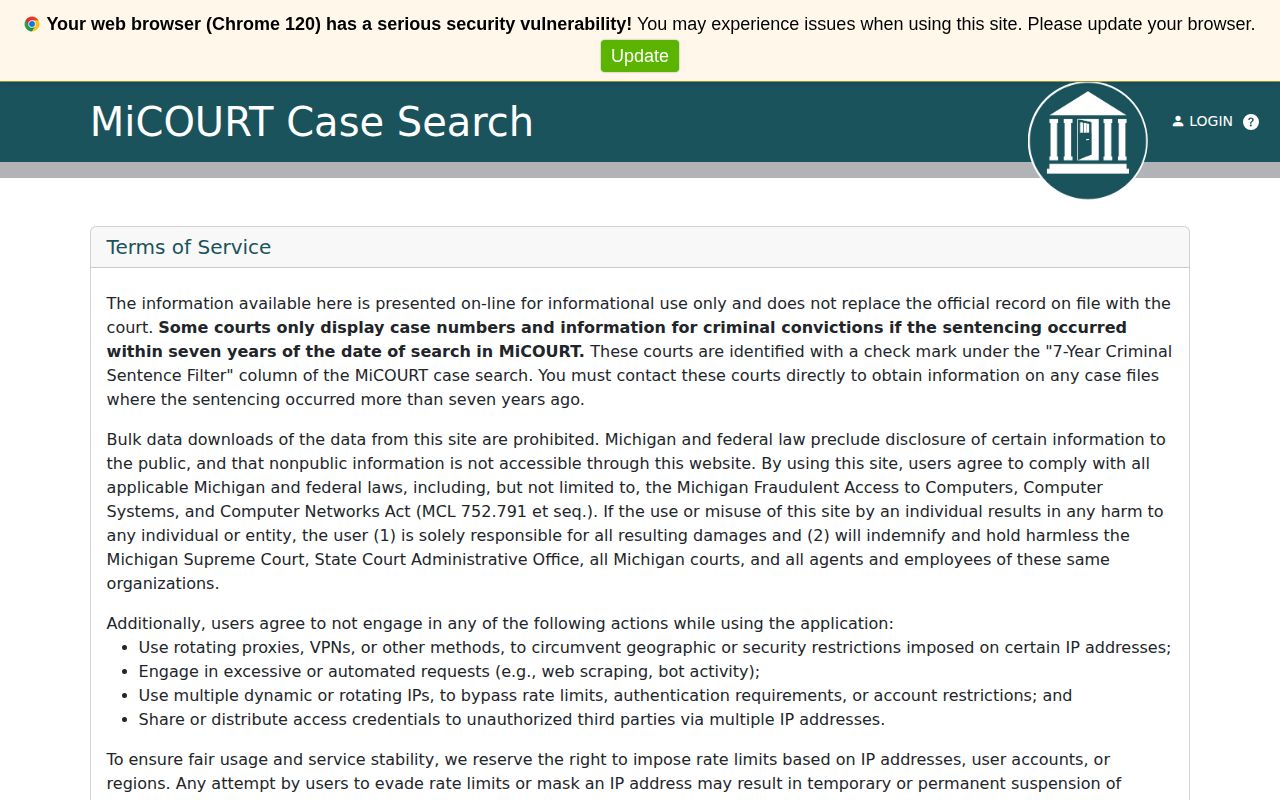
Use the court result to identify the legal action, then use the jail release record for the recorded physical departure.
MDOC Search for Gogebic Releases
The Michigan Department of Corrections Offender Tracking Information System, or OTIS, covers MDOC prisoners, parolees, probationers, and most people discharged within three years after their latest MDOC discharge. It does not include a person whose only custody was Gogebic County Jail. Search with an MDOC offender number when possible because the number points to one record.
| OTIS field | How to use it |
|---|---|
| Last and first name | Required starting point when the offender number is unknown; a last-name wildcard works after three initial characters. |
| Offender number | Best unique match; other search filters are ignored with this number. |
| Status | Choose Parolees, Discharged, or All when checking a past prison release. |
| Sex, race, and age | Narrow namesakes; OTIS applies an age range of plus or minus three years. |
| Marks, scars, tattoos | An exact-text narrowing field. |
| Date Paroled | The recorded date of departure from prison to parole. |
Read Status with all date fields. `PAROLE` means the person is outside prison but still supervised. `DISCHRG` means MDOC jurisdiction ended for that sentence, with the official death caveat. Parole Board Jurisdiction Date is an eligibility date, not a promised exit. Maximum Date is a potential sentence endpoint.
The live OTIS search capture shows the official state-offender route.
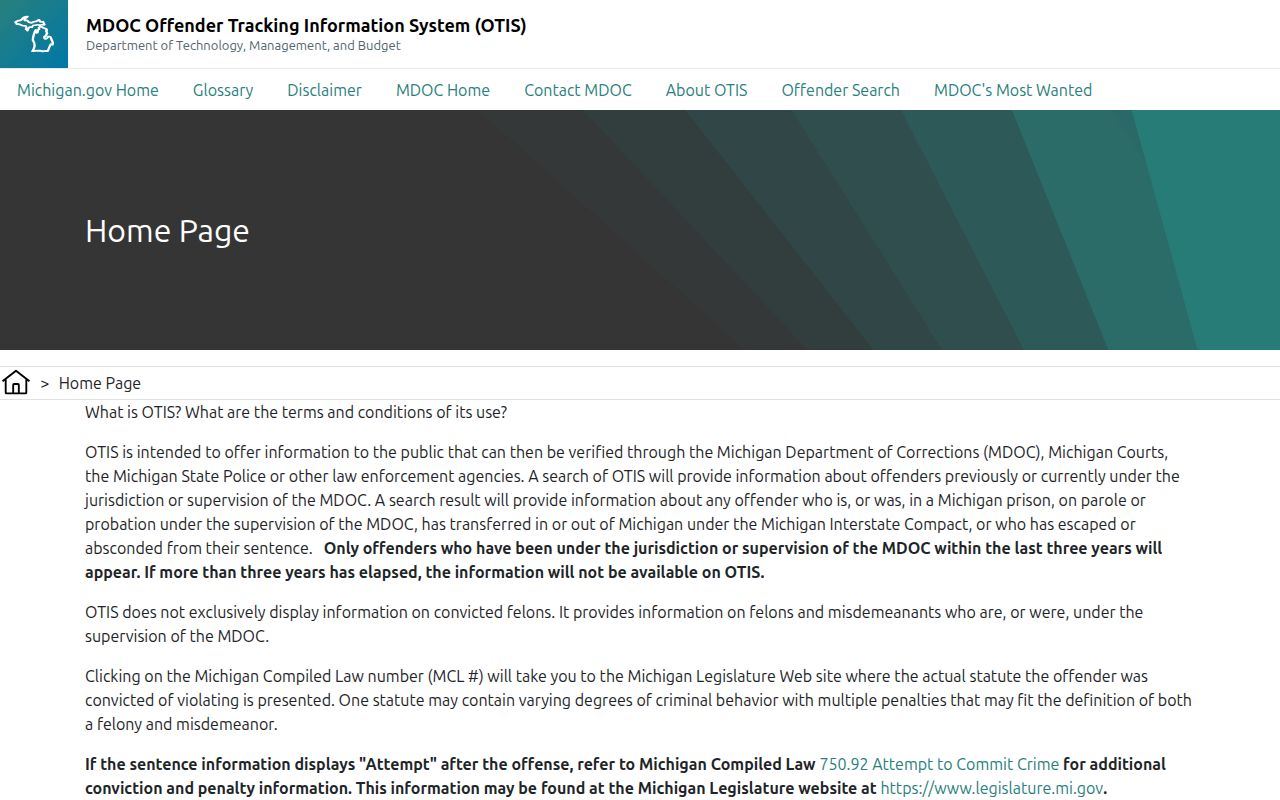
This state search should follow a Gogebic jail check only when the case involved MDOC custody or supervision.
Gogebic County Recent Releases
As of the research date, the Sheriff and jail pages published no person search, roster, 24-hour list, 72-hour list, archive, booking-detail page, update time, or post-release retention rule. No official Sheriff inmate app was found. Those are affirmative audit findings, not proof that the jail creates no records.
For a defined interval, ask through FOIA for an existing release log or export with exact local start and end times. Request release type and receiving destination if maintained. A later-produced log is not a live feed, and a departure to MDOC, USMS, another county, or ICE must be labeled as a transfer.
The official Sheriff page supplies the custody contact and other agency links.

The page does not provide a complete release dataset, so direct contact and the formal record remain central.
Gogebic Release Supervision Check
OTIS separates Parolees, Probationers, Parole Absconders, and Probation Absconders. Parole proves a prison departure into supervision. Probation does not prove that a state-prison release happened because a court may impose it after jail or instead of prison. An absconder is away from supervision without authority and is not a person in good standing.
The MDOC Gogebic County Parole/Probation office is at 200 N. Moore Street in Bessemer and can address assigned-office or status questions. District Court probation works separately even though local post-custody offices share the courthouse. Verify the exact supervision type before contacting either office.
Gogebic Probation Early Discharge
Gogebic District Court publishes a specific early-discharge route. Its instructions say a case may qualify after half the probation term when all conditions are complete and there were no violations for at least three months before eligibility. Excluded convictions and other limits still apply under MCL 771.2.
The probation officer may request discharge. Otherwise, the instructions describe SCAO form MC 512, a letter to the judge, submission through the probation officer, and a follow-up after 14 days. This is a later end to supervision. It does not establish when the person first left Gogebic County Jail.
Gogebic Release Alerts and Federal Checks
MI-VINE is free, confidential, and available around the clock for covered Michigan custody and court events. It can send web, telephone, or email notice for release, transfer, escape, and other status changes. Register before an expected event. A transfer alert must not be restated as community release, and a missing past result is not a permanent historical finding.
Federal systems are separate. The BOP locator covers sentenced federal prisoners from 1982 forward and can show a release date or `Not in BOP Custody`. That wording does not rule out another agency or supervision. ICE’s locator can include some people released from ICE custody during the prior 60 days. Search by a nine-digit A-number and country of birth, or exact name and country of birth.
Release from Gogebic County Jail to ICE is a transfer. An ICE check-in later is an administrative appointment, not an immigration-court hearing. USMS has no broad public locator like BOP; a focused FOIA request may be needed for federal pretrial processing records.
Match Gogebic Release Sources
Each source measures a different event. A court may authorize release before the jail processes the exit. MI-VINE may send notice after the feed receives the change. OTIS may shift from prisoner to parolee after MDOC finishes its own release processing. Prefer the office-created event record for the exact fact in dispute.
| Question | Best source | Limit |
|---|---|---|
| In Gogebic County Jail now? | Jail telephone | Does not provide a full departure history |
| Exact county departure? | Sheriff release record | May not resolve a later hold |
| Legal basis? | D98 or C32 court file | May not show physical exit time |
| State-prison parole? | OTIS Status and Date Paroled | Does not cover jail-only custody |
| Covered custody alert? | MI-VINE | Not a complete historic archive |
| Federal prison release? | BOP locator | Does not clear other custody |
Gogebic County Release Facilities
Gogebic County Jail is the active local custody point. Someone leaving it may return to the community after bond, dismissal, time served, a court order, or sentence completion. The person may instead transfer to MDOC or another authority. Call the jail, check the court, use MI-VINE, and request the release sheet to distinguish those outcomes.
Ojibway Correctional Facility is historical. It began as Camp Ojibway in 1971, later operated as a secure male MDOC prison with capacity up to 1,180, and closed December 1, 2018. Nobody is released from it now. Search former prisoners through OTIS or MDOC records, and do not assume a historic facility label identifies where a person completed custody.
No active state prison, federal prison, ICE detention center, USMS detention facility, or separate municipal lockup was identified within Gogebic County. A person tied to a local case may still be held elsewhere. Search by the custody authority, not by county geography alone.